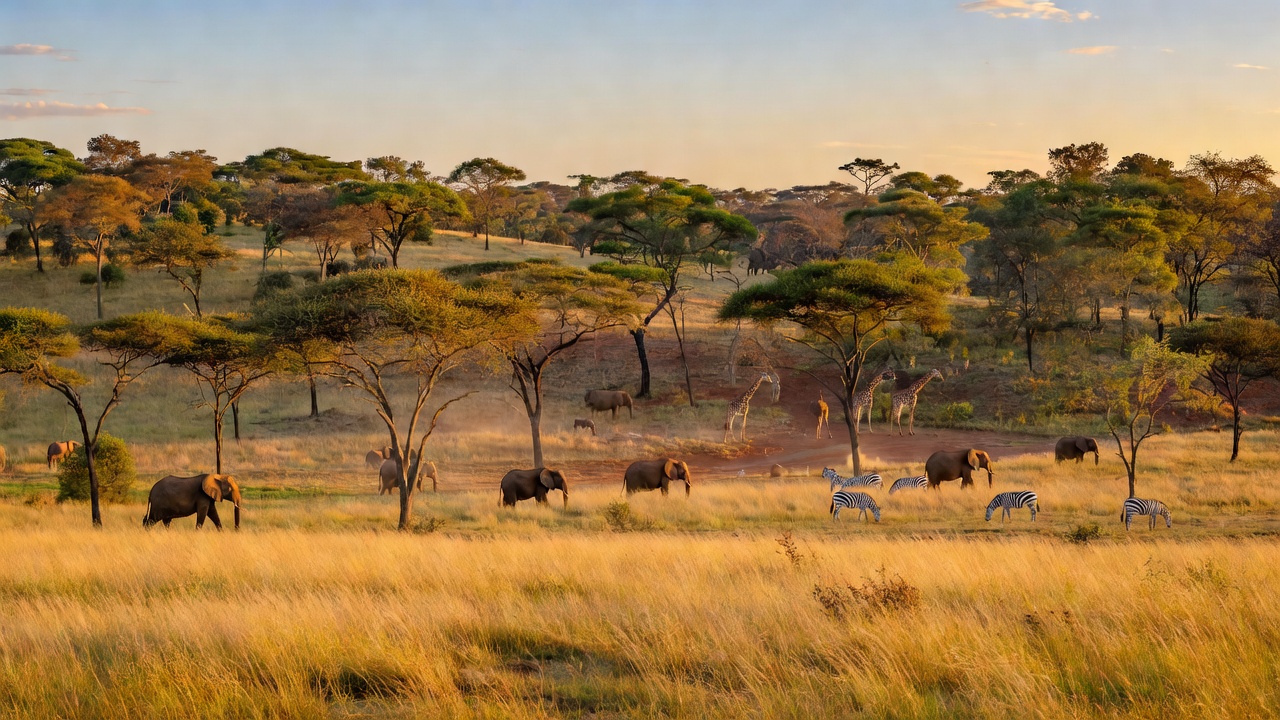
Connectivity is an objective, not a line on a map.
The Kavango Zambezi Transfrontier Conservation Area brings a landscape perspective to conservation across Angola, Botswana, Namibia, Zambia and Zimbabwe. Real connectivity still depends on what animals and people encounter on the ground.
Protect journeys as well as destinations.
Protected areas can conserve important habitat, but animals may need seasonal resources beyond their boundaries. A corridor is useful only if it connects suitable places and remains practically passable. Its value depends on the species: an elephant, a dispersing wild dog and a small grassland mammal do not experience roads or fences in the same way.
The Kavango Zambezi Transfrontier Conservation Area offers a real example of conservation planned across national borders. Cooperation can support a wider landscape perspective, yet a shared designation does not automatically remove barriers, resolve land disputes or guarantee safe movement. Local land use, infrastructure and governance remain decisive.
Fences illustrate the trade-offs. They may help separate wildlife from some hazards or support management, but can also restrict movement and access to water. Removing a fence without considering livestock disease, livelihoods or conflict can create new problems. Effective habitat protection asks whose risks change and what support accompanies a decision.
Ask who carries the costs.
People living beside wildlife may experience crop loss, livestock predation, property damage and threats to personal safety. Benefits celebrated by distant visitors may not reach the households bearing those costs. Respectful conservation treats residents as rights-holders and decision-makers, not as scenery around a protected area.
Community conservancies in Namibia are one example of institutions designed to connect wildlife management with local participation and benefits. Results vary among places and over time. The useful questions concern governance, representation, income distribution and accountability, rather than whether a model has an appealing name.
Practical measures can include stronger livestock enclosures, better herding, early warning and carefully designed crop protection. Their effectiveness depends on maintenance, local conditions and who has access to them. Compensation may help in some circumstances, but slow payments or difficult eligibility rules can undermine confidence. No single tool replaces sustained relationships.
Look for trends, methods and honest limitations.
A large number of sightings is not, by itself, proof of successful conservation. Animals may be concentrated around remaining water, drawn into a smaller area or easier to see after vegetation changes. Monitoring needs repeatable methods, appropriate timescales and an understanding of detection: animals that are present are not always observed.
The IUCN Red List evaluates extinction risk using defined criteria. It is a valuable reference, but a global category is not a complete report on every local population. Similarly, a rising count at one reserve does not necessarily indicate recovery across a species’ range. Always check what area, period and method a claim describes.
Protection also involves ranger welfare, lawful enforcement and respect for human rights. Wildlife crime prevention should not be reduced to dramatic patrol imagery. Investigations, fair institutions, safe working conditions and cooperation with communities can be less visible but essential. Strong conservation communication makes room for these institutional foundations.
Follow the claim to the mechanism.
Tourism can contribute revenue, employment and incentives to retain habitat. It can also create disturbance, uneven benefits and dependence on an unstable market. Before choosing a safari business, ask what conservation payments fund, how local employment is supported and whether independent reporting is available. A leaf-shaped badge is not evidence.
For donations, look for a clear purpose, named governance, accessible reporting and an explanation of how results are assessed. Distinguish money spent on an activity from evidence that the activity improved an outcome. Be cautious of promises that one purchase will “save” a species or remove a complex threat.
Your on-site choices matter too. Respect viewing rules, do not request off-road access where it is prohibited, and avoid posting sensitive live locations of threatened wildlife. Conservation is rarely one heroic intervention. It is usually a long sequence of decisions that keeps habitat functioning and makes protection workable for the people who share it.
Read further
- Kavango Zambezi Transfrontier Conservation Area
- NACSO: Namibia’s community conservation
- IUCN Red List of Threatened Species
- IUCN: conservation policy and practice
Examples are educational, not endorsements. Zuvirosafar is not affiliated with the organisations listed.