Read a mixed herd without inventing a partnership.
Zebra and wildebeest often occupy the same broad landscapes, including the Serengeti–Mara system. Their feeding preferences and digestive systems differ, allowing them to use vegetation in different ways. Under some conditions, one grazer’s feeding can alter a patch in ways another can exploit. Ecologists call a beneficial effect of this kind facilitation.
That does not mean the animals have formed a deliberate agreement. When food or water becomes scarce, overlapping needs can produce competition. A relationship may change with season, population density or plant growth. “They help each other” is therefore less useful than asking which resource is changing and how each species responds.
Mixed groups may also gain information from one another’s vigilance or alarm behaviour. Yet a photograph cannot show whether one species actually benefits. Watch for evidence: are heads rising after an alarm, are animals moving together, or are they simply using the same patch? Observation becomes stronger when it separates what happened from an explanation that still needs testing.
Risk matters even without a chase.
Lions, leopards, cheetahs, spotted hyenas and African wild dogs have different hunting strategies and habitat requirements. Prey respond to combinations of visibility, cover, group size and recent experience. An animal may trade a rich feeding patch for a place where danger is easier to detect. Ecologists study such trade-offs alongside direct predation.
Predator effects can extend through food webs, but simple claims about a universal “balance of nature” hide important differences. Rainfall, disease, hunting, livestock and habitat change can all influence populations. A trophic cascade documented in one ecosystem should not be assumed to operate identically in every African protected area.
Spotted hyenas are capable hunters as well as scavengers; lions also scavenge. Labels such as “noble hunter” and “thief” import human moral stories into flexible feeding behaviour. Instead, ask who obtained the food, who can defend it, and how competition changes access. Never move a vehicle to influence the outcome of an encounter.
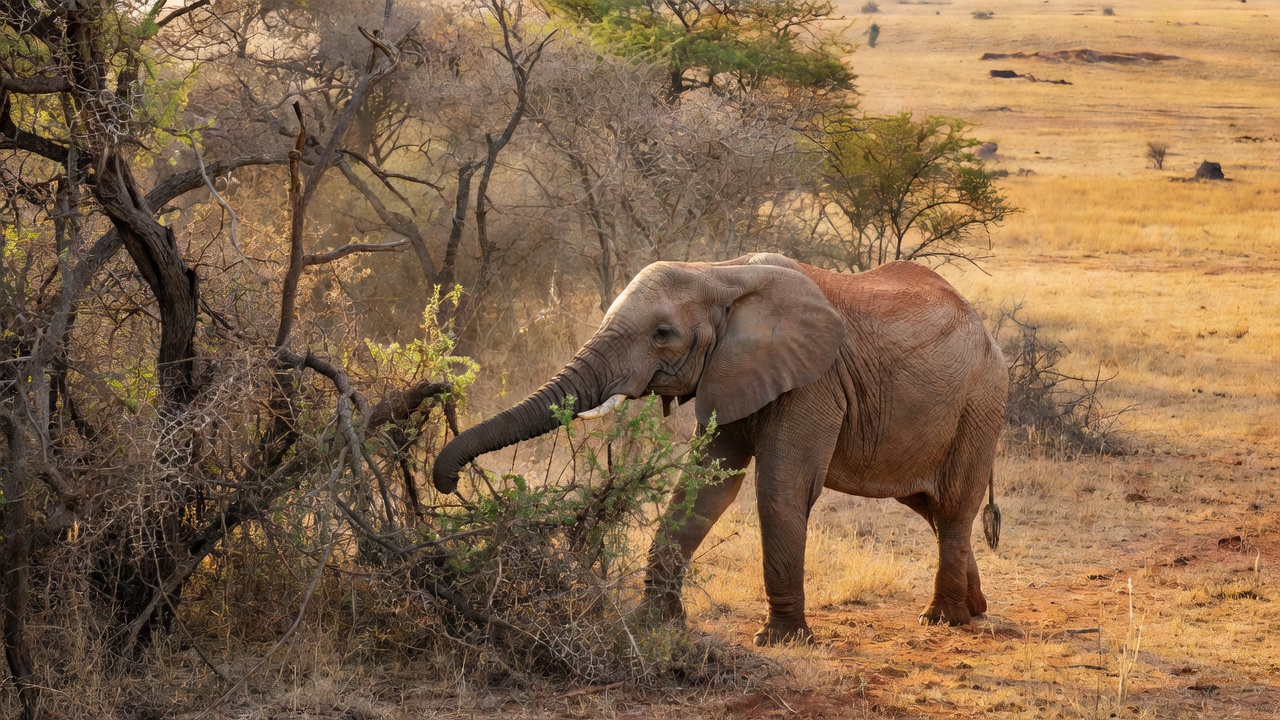
Elephants leave more than footprints.
Elephants browse, strip bark, break branches and sometimes push over trees. They also disperse seeds in dung and create paths used by other animals. These activities can alter the balance of open and woody patches. Their ecological role is broad, but the outcome depends on vegetation, rainfall, elephant density and access to space.
A broken tree is not enough evidence to declare a landscape damaged. Equally, calling elephants “ecosystem engineers” does not make every local effect beneficial for every species. Some organisms gain habitat while others lose it. Conservation managers must consider the pattern over time rather than choosing a verdict from one dramatic scene.
Giraffes, browsers such as kudu, and smaller herbivores also influence plants. Plants respond with regrowth, chemical defences and changes in form, depending on species and conditions. Looking for browsing lines or repeatedly used branches can reveal relationships that remain visible long after the animal has left.
Scavengers and decomposers connect the rest.
A carcass supports a succession of users rather than a single dramatic feeding event. Mammalian scavengers, vultures, insects and microbes exploit different tissues and stages of decay. Nutrients eventually return to soils and plants. The sequence varies with habitat, temperature, carcass size and which animals can find or access it.
Vultures are especially important scavengers, but many African species face severe threats, including poisoning. A poisoned carcass can harm animals far beyond its intended target. Conservation therefore has to connect wildlife crime prevention, livestock conflict responses, veterinary practices and community reporting. Protecting a food web is not limited to protecting its most photographed predator.
Use a patient field method: identify the organisms, describe the behaviour, note the surrounding habitat, then suggest more than one explanation. An oxpecker on a large mammal, for example, is not proof of an uncomplicated mutual benefit; feeding behaviour and host responses matter. The most rewarding safari interpretation leaves room for uncertainty while making the underlying ecological questions clearer.